
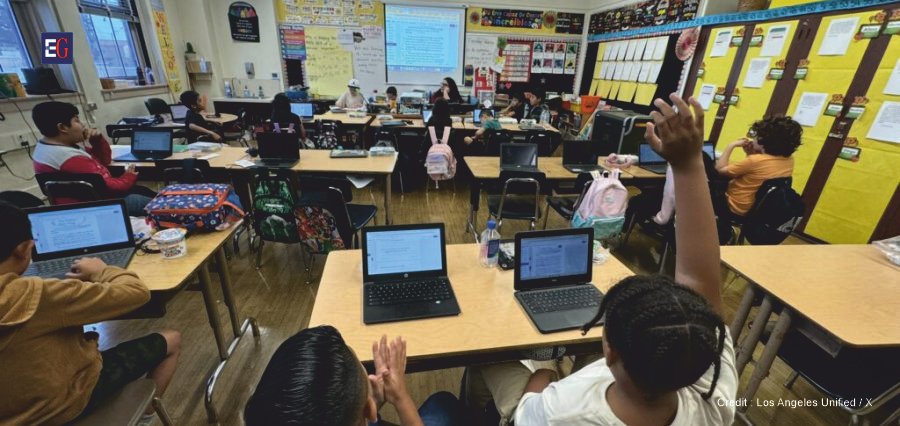
Los Angeles is moving to reduce students’ dependence on digital devices in classrooms, with the city’s education board approving new restrictions on screen use across its vast public school system.
The policy will require schools to develop screen-time rules based on students’ grade levels. Under the new approach, children in first grade and younger will be prohibited from using digital devices for classroom learning.
The move affects a school district serving roughly half a million students and represents a major shift in how technology is being used in education. Tablets and laptops became central to classroom learning during the COVID-19 pandemic, when schools relied heavily on digital tools to maintain lessons while students were learning remotely.
With regular classroom teaching now firmly restored, education officials are seeking to reassess how much time students should spend looking at screens during the school day.
The resolution was introduced by board member Nick Melvoin, who argued that digital devices played an essential role during the pandemic but that schools now have an opportunity to reconsider their place in everyday education.
The restrictions are expected to take effect during the next school year, giving schools time to develop policies appropriate for different age groups.
YouTube and Streaming Platforms Face New Restrictions
A major part of the policy will involve restricting access to entertainment-oriented digital content on school-issued devices.
YouTube and other video-streaming platforms will be blocked on school devices under the new rules, reducing opportunities for students to use classroom technology for purposes unrelated to their lessons.
The decision reflects growing concerns among educators and policymakers that unrestricted access to digital devices can make it harder for students to remain focused during lessons. While tablets and laptops can provide access to educational resources, they can also create distractions when students are exposed to videos, games and other online content.
The Los Angeles policy does not eliminate technology from schools altogether. Instead, it seeks to establish greater limits around when and how devices are used, with age and grade level playing an important role.
The board’s decision follows another major technology-related policy introduced by the district in 2024, when officials approved restrictions on mobile phones and social media use in classrooms.
Together, the measures reflect a broader attempt to create more focused learning environments by reducing students’ exposure to personal and recreational digital activity during school hours.
The shift also comes as educators around the world reconsider the balance between traditional classroom instruction and technology-based learning. Digital tools remain valuable for research, communication and interactive lessons, but schools are increasingly examining whether greater screen exposure necessarily produces better educational outcomes.
Concerns Over Children’s Health and Learning Influence Policy
Health and learning concerns were among the factors cited in support of the new restrictions.
The resolution referred to research involving children between 8 and 11 years old, indicating that those who exceed recommended screen-time levels may face higher risks of obesity and depressive symptoms and may perform less well on certain cognitive assessments.
The findings have added to a growing debate about the amount of time children should spend using smartphones, tablets and computers, particularly during their formative years.
For Los Angeles schools, the policy represents an effort to restore greater balance between digital and non-digital learning. Younger children, in particular, will have less exposure to school-issued devices, potentially creating more opportunities for reading, writing, classroom discussion, hands-on activities and direct interaction with teachers and classmates.
The decision could also become an important reference point for other large school districts considering similar policies. Los Angeles is among the first major U.S. school systems to establish comprehensive restrictions on classroom screen use, making its implementation likely to receive close attention from educators and policymakers elsewhere.
The challenge will be ensuring that reduced screen time does not limit students’ access to useful educational technology. Schools will need to determine when digital tools genuinely improve learning and when traditional teaching methods may be more effective.
As classrooms continue adapting to the lessons of the pandemic era, Los Angeles is signaling that technology should remain a tool for education rather than becoming the centre of it. The new policy marks a significant reconsideration of digital learning and reflects growing efforts to place student attention, wellbeing and classroom engagement at the heart of education.